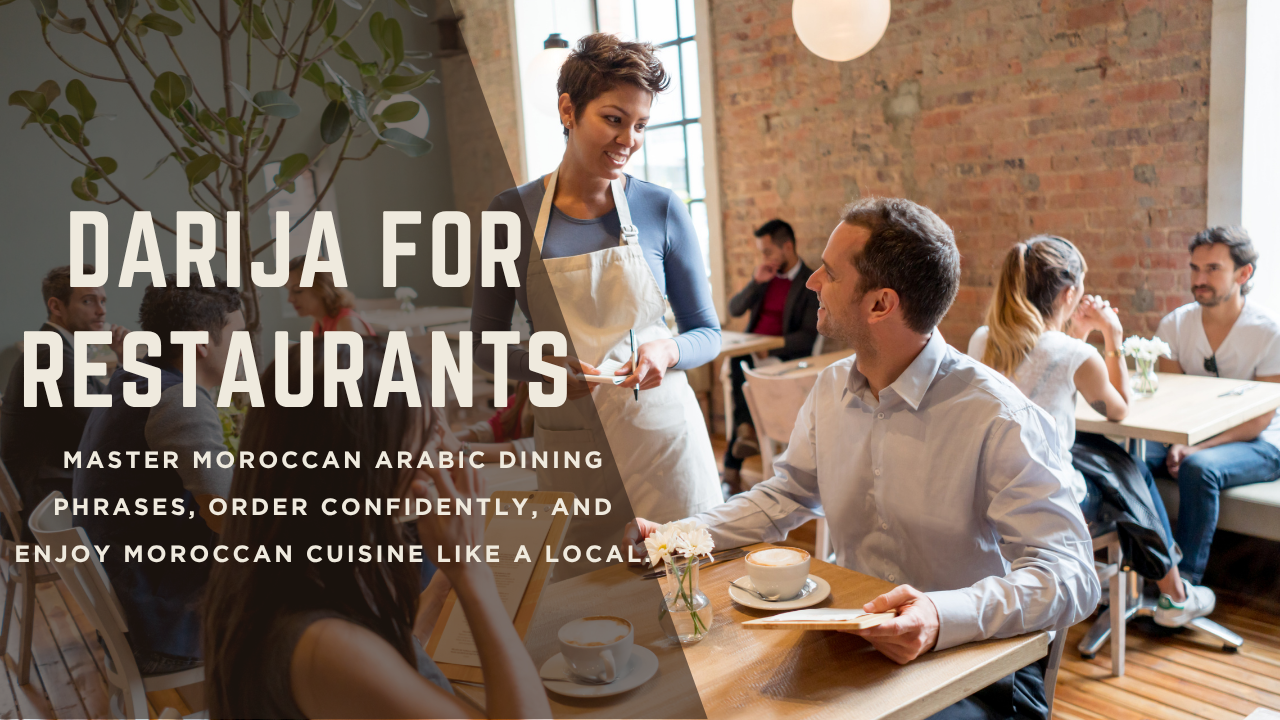
Darija for Restaurants: Essential Moroccan Dining Phrases
Written by Abdul · Native Moroccan Arabic teacher, founder of Daily Darija
Published on · Updated October 27, 2026 · 9 min read
Quick answer: To read a Moroccan menu in Darija, learn the dish names first: tajine (طاجين), ksksu (كسكسو, couscous), 7rira (حريرة, soup), and the meats djaj (دجاج, chicken), l7am (لحم, red meat) and 7out (حوت, fish). To ask for a dish without something, use bla (بلا) → “without”, pronounced bla. For allergies, say 3ndi 7asasiya mn… (عندي حساسية من) → “I am allergic to…”.
Example: Bghit tajine dyal khodra, bla l7am, 3afak = I want a vegetable tajine, without meat, please 🥘
Introduction
Eating out in Morocco is an experience full of flavors, smells, and culture. But if you don’t speak Darija, ordering at a restaurant or café can feel tricky.
In this guide, you’ll learn essential Moroccan Arabic (Darija) phrases to use in restaurants, cafés, and street food stalls — so you can order confidently and enjoy your meals like a local.
Think of this article as your Moroccan menu decoder: the names of the dishes, the ingredients inside them, how to explain a diet or an allergy, and how to pay at the end. If you only need the basic words to order and ask for the bill, my guide on ordering food and drinks in Darija covers that step by step. 🇲🇦
Basic Restaurant Phrases
| English | Darija | |
|---|---|---|
| I would like… | Bghit… | |
| Menu, please | Lmenu 3afak | |
| What do you recommend for me? | Shnu katnsa7ni? | |
| I’m hungry | Fiya jou3 | |
| I’m full | Shba3t | |
| Bill, please | La7sab, 3afak |
Tip: Start your order with “bghit…” — it’s the polite and common way to say “I would like…” in Morocco.
🗣️ Pronunciation tip: fiya jou3 (فيا الجوع) literally means “hunger is in me”; the “3” at the end is the deep throat sound of the letter ع. Shba3t (شبعت) → “I am full” is the magic word when a Moroccan host keeps filling your plate.
Ordering Drinks
| English | Darija | |
|---|---|---|
| I want tea | Bghit atay | |
| With mint | B na3na3 | |
| I want coffee | Bghit 9ahwa | |
| Water, please | Lma 3afak | |
| Juice | L3asir |
Cultural note: Moroccans often enjoy tea with every meal. Offering a guest tea is considered polite.
Two drink words that surprise learners: 3asir limoun (عصير ليمون) is orange juice, not lemon juice, and atay bla skkar (أتاي بلا سكر) → “tea without sugar” is the phrase to know if you do not want the (very) sweet default.
Ordering Food
| English | Darija | |
|---|---|---|
| I want chicken | Bghit djaj | |
| I want beef | Bghit l7am lbagri | |
| I want fish | Bghit l7out | |
| Vegetarian dish | Nabati | |
| Spicy | 7ar | |
| Not spicy | Mashi 7ar |
Tip: Always ask about spice level if you’re not used to Moroccan food — many dishes are flavorful and spicy.
Moroccan dishes you will see on every menu
Most menus in Morocco are written in French or Arabic, and the waiter will say the dish names in Darija. Here are the ones you will meet again and again:
| Darija | Arabic | English |
|---|---|---|
| tajine | طاجين | slow-cooked stew in a clay pot (meat, chicken or vegetables) |
| ksksu | كسكسو | couscous, traditionally served on Fridays |
| 7rira | حريرة | tomato, lentil and chickpea soup |
| bissara | بيصارة | fava bean soup with olive oil and cumin |
| tanjia | طنجية | Marrakech meat slow-cooked in a clay urn |
| rfissa | رفيسة | chicken with lentils on shredded msemen |
| bastila | بسطيلة | pastilla: sweet and savory pie (chicken or seafood) |
| mshwi | مشوي | mechoui, roasted lamb |
| kefta | كفتة | minced meat (kebabs or meatballs) |
| zaalouk | زعلوك | cooked eggplant and tomato salad |
| taktouka | تكتوكة | cooked green pepper and tomato salad |
| msemen | مسمن | layered square flatbread |
| bghrir | بغرير | spongy “thousand-hole” pancakes |
| sffa | سفة | sweet vermicelli or couscous with cinnamon and almonds |
When in doubt, ask shnu fih? (شنو فيه) → “what is in it?”. Moroccan cooks are proud of their dishes and will happily list every ingredient.
Ingredients in Darija: Meat, Vegetables and Spices
These are the words you need to understand the answer to shnu fih? and to say what you do or do not eat:
-
Meat and protein: l7am (لحم) → red meat, lbagri (البكري) → beef, lghnmi (الغنمي) → lamb, djaj (دجاج) → chicken, 7out (حوت) → fish, lbid (البيض) → eggs.
-
Vegetables: khodra (خضرة) → vegetables, batata (بطاطا) → potatoes, matisha (مطيشة) → tomatoes, bsla (بصلة) → onion, touma (تومة) → garlic, zitoun (زيتون) → olives.
-
Basics: khobz (خبز) → bread, zit l3oud (زيت العود) → olive oil, l7lib (الحليب) → milk, skkar (سكر) → sugar, mel7a (ملحة) → salt.
-
Spices: kamoun (كمون) → cumin, zenjbil (زنجبيل) → ginger, kherkoum (خرقوم) → turmeric, 9erfa (قرفة) → cinnamon, felfla 7arra (فلفلة حارة) → chili.
Dietary Needs in Darija: Vegetarian, Allergies, Halal and Spice Level
This is the part most phrasebooks skip, and the part my students ask about the most. Here is how to explain what you can and cannot eat:
-
Ana nabati (أنا نباتي) → “I am vegetarian” (a woman says ana nabatiya). Even clearer: makanakulsh l7am (ما كناكلش اللحم) → “I don’t eat meat”.
-
Wash fih l7am? (واش فيه اللحم) → “Is there meat in it?” Replace l7am with any ingredient: wash fih lbid? (eggs), wash fih l7lib? (milk).
-
3ndi 7asasiya mn… (عندي حساسية من) → “I am allergic to…”: lkawkaw (peanuts), lluz (almonds), l7lib (milk), lbid (eggs), l7out (fish), lgluten (gluten, said the French way).
-
Bla…, 3afak (بلا) → “without…, please”. Tajine bla batata = tajine without potatoes.
-
Mashi 7arr, 3afak (ماشي حار) → “not spicy, please”. For a little heat: shwiya dyal l7arr → “a little spicy”.
-
3ndi s-sukkar (عندي السكر) → “I have diabetes”. Useful when the tea arrives already sweetened.
🇲🇦 Cultural Note: In Morocco, all meat is halal by default and you will almost never see pork on a menu, so you do not need to ask. Alcohol is served only in licensed restaurants and hotels; in a normal café or snack, it is simply not on the menu. Vegetarian travelers eat very well here: tajine dyal khodra, bissara, zaalouk, taktouka and khobz make a full meal.
Asking Questions at the Restaurant
| English | Darija | |
|---|---|---|
| What is this? | Shnu hada? | |
| Is it good? | Wash mezyan? | |
| Can I have it without…? | Na9dar nakhdoh bla…? | |
| Is it vegetarian? | Wash nabati? | |
| Can I have the bill? | La7sab 3afak? |
Pro tip: Moroccans appreciate when you try to speak Darija, even just a few words. They usually respond warmly!
Paying and tipping in Darija
-
L7sab, 3afak (الحساب عفاك) → “The bill, please.” In Morocco the waiter waits for you to ask.
-
Wash s-service m7soub? (واش السيرفيس محسوب) → “Is service included?”
-
Wash kat9eblu la carte? (واش كتقبلو لا كارت) → “Do you accept cards?” Many small places are cash only.
-
Khelli s-sarf (خلي الصرف) → “Keep the change.” The waiter may answer Allah ykhlef → “may God repay you”.
How much to tip? In a café, 2 to 5 dirhams on the table is normal. In a restaurant, 10 to 20 dirhams or about 10% of the bill. Learn the numbers you need for prices in how much is this in Moroccan Arabic.
Street Food & Casual Dining
If you’re eating in street stalls or local cafés, here are extra useful phrases:
| English | Darija | |
|---|---|---|
| How much is this? | Bsh7al hada? | |
| Too expensive | Ghali bezaf | |
| Can you make it cheaper? | N9as shwiya | |
| I’m just looking | Ghir kanshof |
Tip: Bargaining is expected at markets, but less common in formal restaurants.
Street food has its own menu words: bocadillo (بوكاديو) → a sandwich, sfenj (سفنج) → Moroccan doughnuts, babbouche (ببوش) → snail soup, sardin mshwi (سردين مشوي) → grilled sardines, and ma9la (مقلة) → fried fish. Prices are fixed at food stalls; the bargaining phrases above are for the souk, which I cover in Darija for bargaining.
Mini-Dialogue: Ordering with a Dietary Request
Here is how a real conversation sounds when you need to explain what you eat:
You: Salam. Shnu fih had tajine? — Hello. What is in this tajine?
Waiter: Fih l7am, lbar9o9 w lluz. — It has meat, prunes and almonds.
You: Ana makanakulsh l7am. Wash kayn shi 7aja nabatiya? — I don’t eat meat. Is there something vegetarian?
Waiter: Kayn tajine dyal khodra, w kayna bissara. — There is a vegetable tajine, and there is bissara.
You: Mzyan. Bghit tajine dyal khodra, mashi 7arr 3afak. — Great. I want the vegetable tajine, not spicy please.
Waiter: Wakha. Shi 7aja tshrb? — Okay. Something to drink?
You: 3ndi 7asasiya mn l7lib. Bghit 3asir limoun. — I am allergic to milk. I want an orange juice.
Waiter: Bla mushkil. Hadi shwiya. — No problem. Just a moment.
You (after the meal): Kan bnin bezaf! L7sab, 3afak. — It was delicious! The bill, please.
Cultural Tips for Dining in Morocco
-
Moroccans usually eat with their right hand, especially when sharing traditional dishes.
-
Saying “bismillah” (in the name of God) before eating is polite.
-
Always thank the host or server: shukran (thank you) is simple but appreciated.
-
At traditional Moroccan meals, sharing dishes is common — it’s a sign of hospitality.
When you share a tajine or a couscous, eat from the part of the dish in front of you, use bread as your spoon, and when you have had enough say shba3t, l7amdullah → “I’m full, thank God”. If you are invited to a Moroccan home, my guide to Moroccan hospitality and guest etiquette explains the whole ritual.
Common Mistakes When Reading a Moroccan Menu
-
Thinking “tajine” is one dish. The tajine is the clay pot; what matters is what comes after dyal: tajine dyal djaj, dyal l7am, dyal khodra.
-
Mixing up 7arr and skhoun. 7arr (حار) means spicy; skhoun (سخون) means hot in temperature. Mashi 7arr = not spicy; mashi skhoun = not hot.
-
Saying only “nabati”. Some waiters will bring you a salad. Say what you want: tajine dyal khodra, bla l7am.
-
Expecting pastilla to be savory. Bastila is dusted with sugar and cinnamon on top of chicken or seafood. Delicious, but a surprise if nobody told you.
-
Asking for “lemon” juice. Limoun is orange. Lemon is 7amd (حامض) or citron.
FAQ: Moroccan Menu and Dietary Phrases in Darija
How do you say “vegetarian” in Moroccan Arabic?
Nabati (نباتي) for a man and nabatiya for a woman. The clearest phrase is makanakulsh l7am → “I don’t eat meat”.
How do you say “I am allergic” in Darija?
3ndi 7asasiya mn… (عندي حساسية من) → “I have an allergy to…”, then the ingredient: 3ndi 7asasiya mn lkawkaw = I am allergic to peanuts.
How do you say “not spicy” in Darija?
Mashi 7arr (ماشي حار). Add 3afak to be polite: mashi 7arr, 3afak.
What is harira?
7rira (حريرة) is the Moroccan soup made with tomatoes, lentils, chickpeas and herbs. Moroccans eat it to break the fast in Ramadan, and in restaurants all year round.
How do you ask if service is included in Morocco?
Wash s-service m7soub? → “Is service included?” If not, leave 10 to 20 dirhams in a restaurant and a few coins in a café.
Is all food in Morocco halal?
Yes, in practice: meat in Morocco is halal by default and pork is almost never served. You do not need to ask.
Learn More with Daily Darija
If you enjoyed these restaurant phrases, you’ll love learning more real-life Darija in the Daily Darija courses.
-
Speak confidently in cafés, restaurants, and souks
-
Learn everyday vocabulary and pronunciation
-
Understand Moroccan culture while you learn
🎯 Start learning today: Join the Daily Darija Course
Food is the first unit in my Beginner Darija course for a reason: it is the vocabulary you use three times a day. 🙏
Ready to go further?
Learn to speak Moroccan Arabic with confidence in the Beginner Darija course, or explore all the free Darija resources.