Darija for Taxis and Transportation in Morocco
Written by Abdul · Native Moroccan Arabic teacher, founder of Daily Darija
Published on · Updated October 27, 2026 · 9 min read
Quick answer: To get around Morocco in Darija, you need five transport words and one sentence. The words: taxi (طاكسي) for the petit taxi in the city and the grand taxi between towns, tran (التران) → “train” (the ONCF network), lkar (الكار) → “intercity bus” (CTM), tobis (الطوبيس) → “city bus” and tram (الطرام) in Casablanca and Rabat. The sentence: Bghit namshi l… (بغيت نمشي ل…, bgheet NEM-shi l) → “I want to go to…”.
Example: Salam! Bghit namshi l lagar, 3afak. Bsh7al? = Hello! I want to go to the train station, please. How much? 🚕
Introduction
Getting around Morocco is an adventure — whether you’re hopping into a petit taxi in Marrakech, catching a grand taxi between cities, or navigating public transport. Knowing a few Darija (Moroccan Arabic) phrases will make your journey smoother, safer, and much more fun!
In this post, you’ll learn the most useful Darija transportation phrases to help you take taxis, buses, or trains confidently — just like a local.
This article is my transport hub: all the phrases you need for taxis, trains, buses and trams, in one place, with a vocabulary table in Arabic script. For the practical side of taxis (how the meter works, typical prices, scams to avoid), read how taxis work in Morocco; for a complete ride scripted word by word, read taxi phrases in Darija, step by step.
Types of Taxis in Morocco
Before we jump into phrases, here’s a quick guide:
-
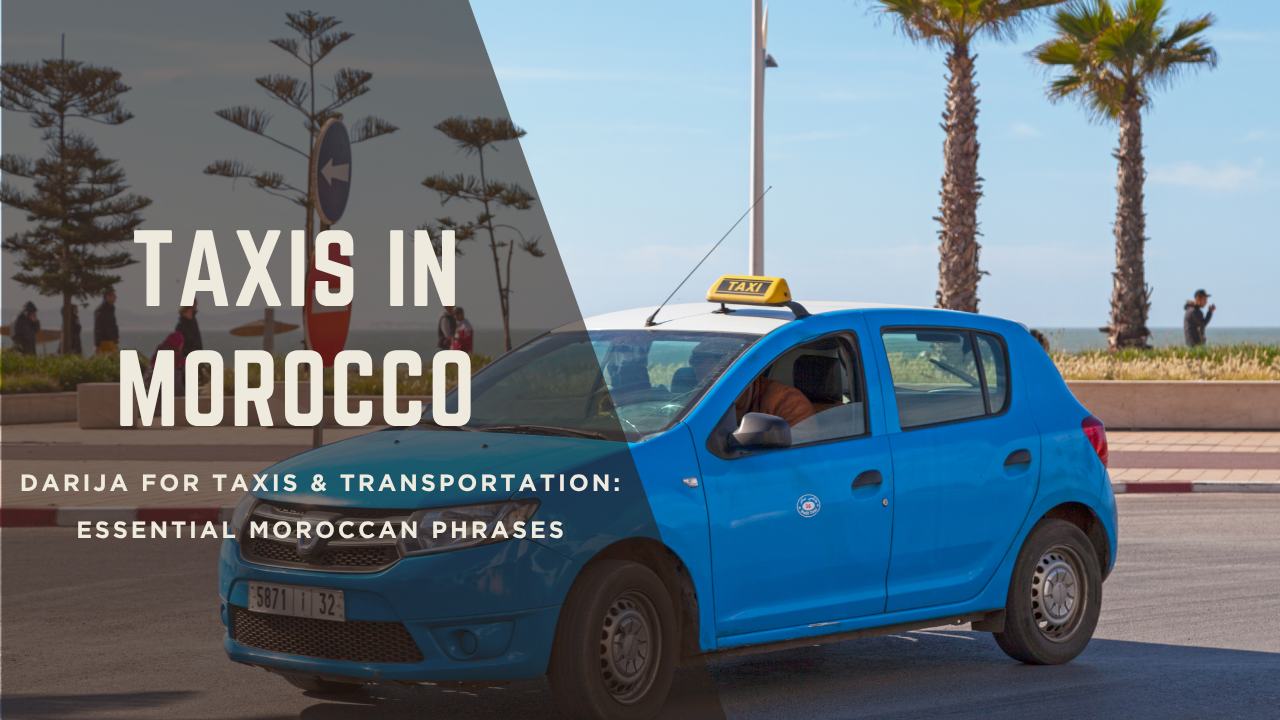
Petit Taxi: Small city taxis (for short distances, up to 3 people).
-
Grand Taxi: Shared long-distance taxis (between towns or cities).
-
Bus: Cheapest option for local routes.
-
Train (ONCF): Comfortable for longer travel, between major cities.
Two more options you will meet: the tram (طرام) in Casablanca and Rabat-Salé, cheap and easy, and Al Boraq, the high-speed train between Tangier, Rabat and Casablanca. In big cities, ride apps also work; Moroccans still call the car a taxi.
Basic Taxi Phrases in Darija
| English | Darija (Transliteration) |
|---|---|
| Taxi! | Taxi! |
| I want to go to… | Bghit namshi l… |
| How much to go to…? | Bsh7al bash namshi l…? |
| Stop here please | W9ef hna 3afak |
| Turn right | Dour limn |
| Turn left | Dour lisr |
| Go straight | Sir nishan |
| Thank you | Shukran |
Tip: In big cities like Casablanca or Rabat, always make sure the taxi uses the meter (le compteur).
🗣️ Pronunciation tip: Bsh7al (بشحال) has the breathy “7” sound; w9ef (وقف) starts with the “9”, a “k” from the back of the throat. Limn and lisr are often said limen / lisar; both are fine. The meter is lkontor (الكونطور), from the French compteur.
Asking for Directions
| English | Darija (Transliteration) |
|---|---|
| Where is the bus station? | Fin kayna ma7ta dyal tobis? |
| Where is the train station? | Fin kayna ma7ta dyal tran? |
| Is this the right way to…? | Wash hadi hiya tri9 s7i7a l…? |
| How far is it? | B3id wla 9rib? |
| I’m lost | Tlaft / Twadart |
Cultural note: Moroccans are generally helpful — if you ask for directions, most people will go out of their way to guide you!
When the answer comes too fast, say 3awd 3afak, bshwiya (عاود عفاك بشوية) → “repeat please, slowly”. The full guide to understanding directions is in directions in Darija.
At the Train or Bus Station
| English | Darija (Transliteration) |
|---|---|
| One ticket to Marrakech please | Wa7d ticket l Marrakech 3afak |
| What time does it leave? | M3ayash kaykhrrej? |
| When does it arrive? | M3ayash kaywsal? |
| Which platform? | Ash mn ska? |
| Is there a bus to Fes? | Wash kayn lkar l Fes? |
Tip: Morocco’s ONCF trains are reliable and modern — and knowing a few Darija phrases helps you interact naturally with staff or fellow passengers.
More phrases for the ONCF train and the CTM bus
Bghit bilet l Rabat, 3afak. (بغيت بيي للرباط عفاك) → “A ticket to Rabat, please.”
Wash had tran kaywqef f Kenitra? (واش هاد التران كيوقف فالقنيطرة؟) → “Does this train stop in Kenitra?”
Wash had lblasa khawya? (واش هاد البلاصة خاوية؟) → “Is this seat free?”
Sh7al kay-khd tri9? (شحال كيخد الطريق؟) → “How long does the trip take?”
Fin kayn lkar dyal CTM? (فين كاين الكار ديال CTM؟) → “Where is the CTM bus?”
Moroccans use the French word for the train station: lagar (لاگار, la gare). Ma7ta works too, but lagar is what you will hear.
Inside the Taxi
| English | Darija (Transliteration) |
|---|---|
| Can you go faster? | Ksiri shwiya |
| Slow down please | Sir bshwiya 3afak |
| I will get off here | Ghadi nahbat hna |
| How much is it? | Bsh7al? |
| That’s too much! | Ghali bezaf! |
| Keep the change | Khli lik sarf |
Cultural tip: It’s polite to greet the driver with “Salam” when you get in and “Shukran” when you leave.
When you get out, a warm Allah y3awn (الله يعاون) → “may God help you (with your work)” is what Moroccans say to a driver, and it always gets a smile. Numbers for the fare are in Darija numbers 1 to 100.
Common Transportation Words
| English | Darija (Transliteration) |
|---|---|
| Car | Tomobil |
| Bus | Tobis |
| Train | Tran |
| Station | Ma7ta |
| Ticket | Ticket |
| Road | Tri9 |
| Traffic | Z7am |
Transport vocabulary with Arabic script
| Darija | Arabic | English |
|---|---|---|
| petit taxi | بوتي طاكسي | small city taxi |
| grand taxi | گران طاكسي | shared intercity taxi |
| tran | التران | train |
| lagar | لاگار | train station |
| lkar | الكار | intercity bus (CTM, Supratours) |
| tobis | الطوبيس | city bus |
| tram | الطرام | tram |
| ma7ta | المحطة | station / stop |
| bilet / ticket | بيي / تيكي | ticket |
| blasa | بلاصة | seat / place |
| lkontor | الكونطور | the meter |
| ssarf | الصرف | change (coins) |
| z7am | الزحام | traffic |
Polite Expressions to Use
| English | Darija (Transliteration) |
|---|---|
| Please | 3afak |
| Thank you | Shukran |
| Excuse me | Sme7 liya |
| No problem | Mashi moshkil |
Using polite words goes a long way — Moroccans appreciate kindness and respect, especially with taxi drivers and locals!
Trams, City Buses and Grand Taxis: Darija Phrases by Mode of Transport
The tables above cover the basics. Here are the phrases that are specific to each way of getting around Morocco, the way I teach them to my students before they travel. 🚊
On the tram (Casablanca and Rabat-Salé)
Fin kayna ma7ta dyal tram? (فين كاينة المحطة ديال الطرام؟) → “Where is the tram stop?”
Wash had tram kaymshi l…? (واش هاد الطرام كيمشي ل…؟) → “Does this tram go to…?”
Fin nhbet l…? (فين نهبط ل…؟) → “Where do I get off for…?”
9ul liya fin nhbet, 3afak. (قول ليا فين نهبط عفاك) → “Tell me where to get off, please.”
Lma7ta jjaya (المحطة الجاية) → “the next stop”.
Tram tickets come from the machines at the stop, so your Darija is mostly for asking other passengers which direction to take. Moroccans love helping with this; one 3afak and you will have three people explaining the route.
On the city bus (tobis)
Wash had tobis kaymshi l…? (واش هاد الطوبيس كيمشي ل…؟) → “Does this bus go to…?”
Sh7al lbilet? (شحال البيي؟) → “How much is the ticket?” — you pay the driver or the ticket seller on board.
Ghadi nhbet f lma7ta jjaya. (غادي نهبط فالمحطة الجاية) → “I’m getting off at the next stop.”
Wash ba9i b3id? (واش باقي بعيد؟) → “Is it still far?”
Grand taxis between towns
A grand taxi leaves when all six seats are sold, from a station Moroccans call the ma7ta dyal taxiyat (المحطة ديال الطاكسيات). You pay per seat, so the key word is blasa (بلاصة) → “a seat / a place”.
Fin kayn grand taxi l…? (فين كاين گران طاكسي ل…؟) → “Where is the grand taxi to…?”
Bghit blasa l… (بغيت بلاصة ل…) → “I want one seat to…”
Sh7al lblasa? (شحال البلاصة؟) → “How much is one seat?”
Imta ghadi nkhrjo? (إمتى غادي نخرجو؟) → “When do we leave?” — the usual answer is mlli y3mmer, “when it fills up”.
Bghit nkri taxi kaml. (بغيت نكري طاكسي كامل) → “I want to rent the whole taxi.” — if you do not want to wait or share.
Here is a typical exchange at the grand taxi station:
A: Salam! Fin kayn grand taxi l Essaouira? — Hello! Where is the grand taxi to Essaouira?
B: Hna, a sidi. Bghiti blasa? — Here, sir. Do you want a seat?
A: Iyeh, wa7d lblasa. Sh7al? — Yes, one seat. How much?
B: Tmanin drham. — Eighty dirhams.
A: Wakha. Imta ghadi nkhrjo? — Okay. When do we leave?
B: Mlli y3mmer, ba9i juj. — When it fills up, two more to go.
A: Mashi moshkil, shukran. — No problem, thank you.
🇲🇦 Cultural Note: In a grand taxi, the front seat is often shared by two passengers. If you want the front seat for yourself, you pay for two blasat. Nobody will be offended; it is a normal request.
Common mistakes when getting around Morocco
Calling every bus “tobis”. In Darija, tobis is the city bus; the intercity coach (CTM, Supratours) is lkar. Ask for lkar l Fes, not tobis l Fes.
Looking for a timetable at the grand taxi station. There is none; the taxi leaves when it is full. Ask imta ghadi nkhrjo? and expect mlli y3mmer.
Saying “ticket” when you mean a seat. For a grand taxi you buy a blasa (seat), not a ticket. For trains and coaches you buy a bilet / ticket.
Skipping the greeting with the driver. Salam when you get in and shukran, bslama when you get out are expected; the ride goes better with them.
Using Standard Arabic words. Qitar (train) and 7afila (bus) are understood but strange in Morocco; say tran and tobis / lkar.
FAQ: Taxis and Transportation in Morocco in Darija
How do you say “taxi” in Moroccan Arabic?
Simply taxi (طاكسي). A small city taxi is a petit taxi and a shared intercity taxi is a grand taxi; Moroccans use the French names.
How do you say “I want to go to…” in Darija?
Bghit namshi l… (بغيت نمشي ل…), followed by the place: Bghit namshi l lmdina, “I want to go to the medina”.
How do you ask a taxi driver to turn on the meter in Darija?
Sh3al lkontor, 3afak (شعل الكونطور عفاك). The meter is lkontor, from the French compteur. For when the driver refuses, see how taxis work in Morocco.
What is the difference between a petit taxi and a grand taxi in Morocco?
A petit taxi is a small city taxi for up to three passengers, usually with a meter. A grand taxi is a shared six-seat car for trips between towns, paid per seat and leaving when full.
How do you say “train” and “bus” in Darija?
Train is tran (التران); the city bus is tobis (الطوبيس); the intercity coach is lkar (الكار). The high-speed train is called by its name, Al Boraq.
Is it easy to get around Morocco without speaking Darija?
Yes, French works almost everywhere and English in tourist areas. But a few Darija phrases, especially bghit namshi l…, bsh7al? and w9ef hna 3afak, make every ride smoother and often cheaper.
Why Learning Darija for Transportation Helps
When you learn transportation phrases in Darija, you’ll:
✅ Avoid confusion or overpaying
✅ Travel independently and confidently
✅ Connect with locals in authentic ways
“ Speaking even a little Darija turns every taxi ride into a cultural experience. ”
Learn Darija Step-by-Step
Want to go beyond basic phrases? Join the Daily Darija Courses and learn how to:
-
Speak naturally in real-life situations
-
Understand how Moroccans really talk
-
Master pronunciation and confidence through guided lessons
If you want to practice these situations with audio and a native teacher, the Beginner Darija course is the place to start.
🎯 Start today at Join the Daily Darija Course
Ready to go further?
Learn to speak Moroccan Arabic with confidence in the Beginner Darija course, or explore all the free Darija resources.