Why You Should Take a Moroccan Arabic Course (and Not Just Watch Random Videos)
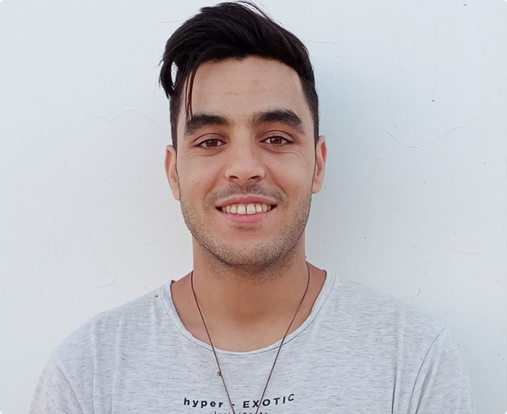
Written by Abdul · Native Moroccan Arabic teacher, founder of Daily Darija
Published on · Updated October 27, 2026 · 9 min read
Quick answer: Self-study (free videos, apps, podcasts) is cheap and flexible, but most learners stall because they don’t know what to learn next, mix Darija with Standard Arabic and get no feedback on their speaking. A structured Moroccan Arabic course saves time by giving you the right order, native pronunciation and real dialogues, so you reach your first conversation sooner. The best combination: a course as your backbone, free content for extra listening.
Example: Kanakhod cours dyal darija online (كناخد كور ديال الدارجة أونلاين), pronounced ka-na-khod koor dyal da-ri-ja = I’m taking a Darija course online.
Introduction
So you’ve decided to learn Moroccan Arabic — great choice! 🇲🇦
Whether you’re moving to Morocco, have Moroccan friends or family, or you just love the culture, learning Darija (Moroccan Arabic) is one of the most rewarding things you can do.
But here’s the big question:
Should you take a Moroccan Arabic course, or can you just learn from YouTube and TikTok?
Let’s talk about why a structured course can save you months of confusion — and how the Daily Darija Course can help you actually speak Darija with confidence.
I will be honest with you: self-study also has real advantages, and some learners do well with it. Below, you get a fair comparison first, then the 7 reasons a course usually gets you speaking faster.
Why Learning Moroccan Arabic Is Different
Many learners start with Modern Standard Arabic (MSA), thinking it’s the same as what Moroccans speak.
But when they arrive in Morocco, they realize… nobody actually speaks MSA in daily life.
That’s because Darija — the Moroccan dialect — is a unique mix of Arabic, Amazigh, French, and Spanish.
So if you want to talk with locals, understand conversations, or even order your favorite tajine without confusion — you need to learn Darija, not MSA.
Why is Moroccan Arabic difficult to learn?
Three things surprise learners. First, Darija drops many short vowels, so words sound compressed: ktab (كتاب, book), mzyan (مزيان, good). Second, it has sounds English doesn’t have, like 3 (ع), 7 (ح) and 9 (ق). Third, there is no official spelling, so every video writes words differently.
None of this makes Darija impossible. It just means that learning alone from random sources is harder than with a guide who explains these points in the right order. For the full picture, read what Moroccan Darija is and how it differs from Arabic.
Why a Moroccan Arabic Course Makes All the Difference
Here’s why taking a structured Moroccan Arabic course is a game-changer compared to self-study:
✅ Step-by-step lessons – you don’t have to guess what to learn next.
✅ Native pronunciation practice – you’ll sound natural, not robotic.
✅ Cultural context – understand when and how phrases are actually used.
✅ Confidence-building exercises – real-life dialogues, not just vocabulary lists.
Without structure, it’s easy to end up memorizing words but not being able to form a simple sentence.
That’s what the Daily Darija Course fixes.
Self-Study vs a Darija Course: Honest Pros and Cons
Here is the comparison I share with every student who asks me whether they really need a course.
| What matters | Self-study (videos, apps, free content) | A structured Darija course |
|---|---|---|
| Cost | Free or very cheap | Paid (you invest money, which also keeps you committed) |
| Flexibility | Total: any time, any topic | High for online, self-paced courses; fixed times for live classes |
| What to learn next | You decide, often by guessing | Already planned, lesson by lesson |
| Darija vs MSA | Easy to mix them up without noticing | 100% Moroccan Darija from the start |
| Pronunciation | No feedback on your 3, 7 and 9 | Native audio, models to copy, and correction in live lessons |
| Speaking practice | Rare, unless you have Moroccan friends | Built into every lesson with dialogues and role-plays |
| Cultural context | Scattered, sometimes wrong | Explained with each phrase: when, with whom, how |
| Motivation | Depends only on you | Clear progress, levels and goals to reach |
| Time to first real conversation | Usually longer, with many plateaus | Usually shorter, because nothing is wasted |
When self-study is enough
If you only need a few polite phrases for a one-week trip, free content is perfect. Start with my guide to learning Moroccan Arabic for free and the Daily Darija podcast. If your goal is to talk with your in-laws, live in Morocco or understand real conversations, a course will save you a lot of time.
7 Reasons a Moroccan Arabic Course Saves You Time
You learn in the right order. Greetings, then introductions, then question words, then verbs. No more jumping from slang to grammar and back.
You only learn Darija. No hours lost on Standard Arabic words that Moroccans never use in the street.
You get pronunciation right from day one. Fixing a bad habit after six months takes longer than learning the sound correctly at the start.
You learn phrases, not lists. A course gives you full sentences like Bghit wa7d atay, 3afak (بغيت واحد أتاي عفاك, I’d like a tea, please) that you can use the same day.
You practice speaking from lesson one. Dialogues and role-plays prepare you for real situations before you face them.
You stop searching. Self-learners spend a surprising part of their study time looking for the next video. In a course, you press “next lesson”.
You see your progress. Levels and modules show you how far you have come, and that keeps you going when motivation drops.
Not sure which level fits you? My guide to Moroccan Arabic course levels explains what you can do at each stage.
What You’ll Learn Inside the Daily Darija Course
The Daily Darija Online Course was designed specifically for non-native learners who want to actually speak Moroccan Arabic.
Here’s a sneak peek:
Level 1: Darija for Beginners
-
Learn essential greetings, numbers, and basic expressions.
-
Introduce yourself and have short, real conversations.
-
Master complex verbs, questions, and sentence structure.
Level 2: Darija for Intermediates
-
Learn advanced grammar, idioms, and real-life phrases.
-
Understand native speed and slang.
-
Practice dialogues about food, family, travel, and daily life.
Each module includes real dialogues, vocabulary lists, and clear English explanations — perfect for beginners.
You can see the details of each level on the Beginner Darija course and Intermediate Darija course pages.
What you can say after a beginner course
Here is the kind of short, real conversation my beginner students handle at the end of Level 1:
A: Salam! Mnin nta? — Hi! Where are you from?
B: Ana mn London, walakin sakn f Rbat. (ولكن ساكن فالرباط) — I’m from London, but I live in Rabat.
A: Wa3r! Kathdr darija? — Great! You speak Darija?
B: Shwiya. Kanakhod cours dyal darija online. — A little. I’m taking a Darija course online.
A: 3lash darija, mashi l3arbiya lfus7a? (علاش) — Why Darija, and not Standard Arabic?
B: 7it lmgharba kayhdro darija f zzn9a. (حيت المغاربة كيهضرو الدارجة فالزنقة) — Because Moroccans speak Darija in the street.
A: Tab3an! 3ndk l7e9. (طبعا! عندك الحق) — Of course! You’re right.
B: Yallah, khassni nmshi. Bslama! — Okay, I have to go. Bye!
A: Bslama, thalla f rassek! (تهلا فراسك) — Bye, take care!
🇲🇦 Cultural Note: Thalla f rassek (literally “take care of your head”) is how Moroccans say “take care” when they leave a friend. Say it and you will hear a big smile in the reply: Wnta tani (“you too”).
What Makes the Daily Darija Course Unique
While other platforms teach “Arabic in general,” Daily Darija focuses 100% on Moroccan Arabic.
Here’s why students love it:
🌍 Taught by a Moroccan teacher – learn the language and culture together.
📱 Available anytime, anywhere – on Kajabi, mobile, or desktop.
💬 Darija-first, English-supported – understand everything you learn.
🎧 Authentic recordings – hear how Moroccans really speak.
You don’t just learn words — you learn how to live and communicate in Morocco.
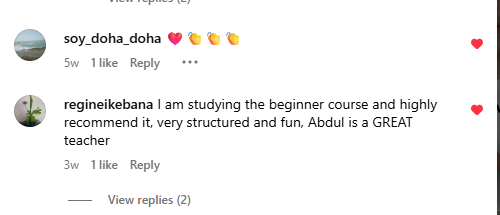
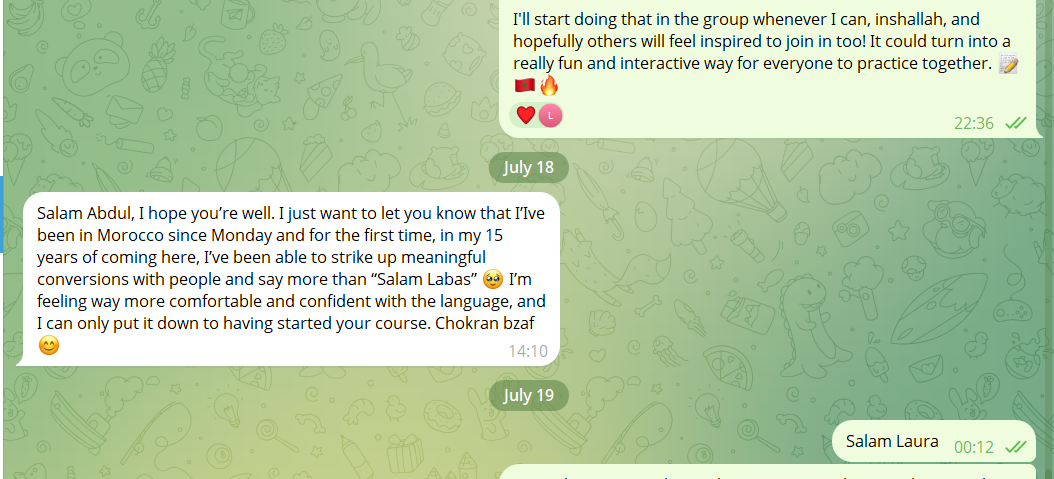
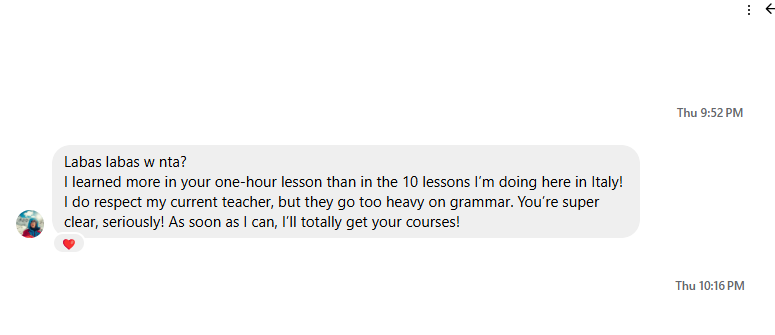
Student Stories
“I tried apps and YouTube videos, but I couldn’t hold a conversation. After joining Daily Darija, I started speaking with my Moroccan in-laws in just a few months!” – Hannah, UK
“It’s not just a Moroccan Arabic course — it’s a cultural experience. I finally understand the humor and warmth behind the words I never understood when I'm my Moroccan in-laws.” – Luca, Italy
Common Mistakes When Choosing Between Self-Study and a Course
Learning Standard Arabic and calling it Darija. Many “Arabic” videos teach MSA. Check that the teacher says bghit (I want) and not uridu.
Buying a course and only watching it. A course works when you repeat out loud and practice the dialogues, not when you watch like a series.
Collecting free videos for months. If you still can’t introduce yourself after three months of self-study, the problem is the method, not you.
Choosing a general Arabic course. For life in Morocco, pick a course that is 100% Moroccan Darija.
Waiting to feel “ready” to speak. Nobody feels ready. Start speaking with simple phrases in week one.
Still hesitating between options? This guide helps you choose the right Moroccan Arabic course for your goal.
FAQ: Taking a Moroccan Arabic Course
Is it better to take a course or self-study Moroccan Arabic?
For a short trip, self-study with free content is enough. For real conversations, a structured Darija course is faster because it gives you the right order, native pronunciation and speaking practice.
Why is Moroccan Arabic difficult to learn?
Darija drops many vowels, uses sounds like ع, ح and ق, and has no official spelling. With a clear course and native audio, these difficulties become manageable in a few weeks.
Can I learn Darija by myself?
Yes, many people learn the basics alone with podcasts and free lessons. Most self-learners progress faster once they add structure and feedback on their speaking.
How do you say “of course” in Darija?
Say tab3an (طبعا), pronounced tab-3an. For a simple “sure, okay”, Moroccans also say wakha (واخا).
How do you say “take care” in Darija?
Say thalla f rassek (تهلا فراسك), pronounced t-hal-la f ras-sek. It is the usual friendly goodbye between friends and family.
How do you say “why” in Darija?
“Why” is 3lash (علاش), pronounced 3-lash: 3lash katt3allem darija? means “Why are you learning Darija?”
Ready to Start Learning Darija?
If you’re serious about learning Moroccan Arabic and want to finally understand and speak with locals, this is your chance.
👉 Join the Daily Darija Course
Learn Moroccan Arabic online, step by step — and start speaking with confidence today
Ready to go further?
Learn to speak Moroccan Arabic with confidence in the Beginner Darija course, or explore all the free Darija resources.