How to Teach Your Child Moroccan Arabic at Home
Written by Abdul · Native Moroccan Arabic teacher, founder of Daily Darija
Published on · Updated October 27, 2026 · 7 min read
Quick answer: To teach your child Moroccan Arabic (Darija) at home, attach one short Darija phrase to each daily routine and say it every day: Sba7 l-khir (صباح الخير, pronounced sba7 l-KHIR, “good morning”) when they wake up, Ghsel ydik (غسل يديك, “wash your hands”) before meals, Tsb7 3la khir (تصبح على خير, “good night”) at bedtime. You don’t need to be fluent: 15 phrases used daily, plus 10 to 15 minutes of songs or lessons, are enough to start.
Example: Yallah nftru! (يالله نفطرو) = Come on, let’s have breakfast! 🍞
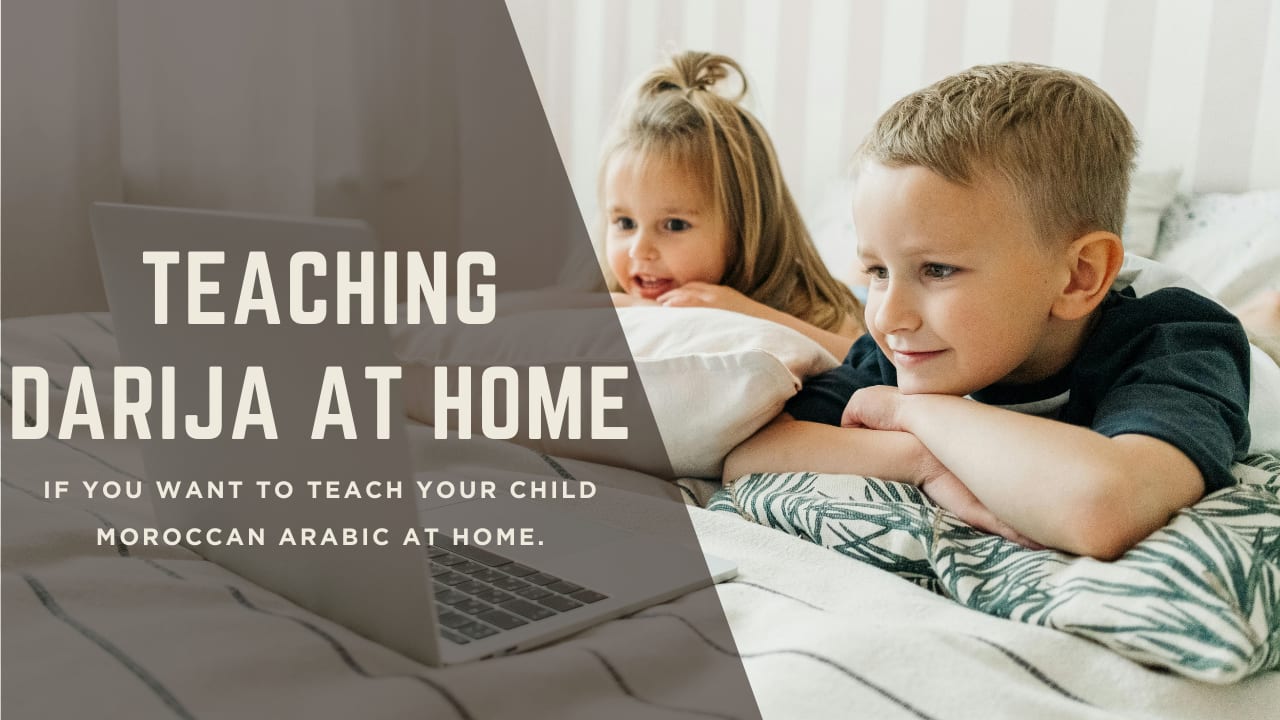
If you want to teach your child Moroccan Arabic at home, the key is to make learning simple, fun, and consistent. Teaching your child Moroccan Arabic (Darija) at home can feel challenging.
- Where do you start?
- What should they learn first?
- How do you keep them motivated?
The truth is:
Children don’t learn languages the same way adults do. They need simple, fun, and consistent exposure.
Let’s see how you can help your child learn Darija at home 👇
And by the way, “home” in Darija is dar (دار), so “at home” is f d-dar (ف الدار). The best Darija school your child will ever have is exactly there 🏠
Start with Simple and Useful Words
Don’t overwhelm your child. Start with basic vocabulary:
- Greetings
- Family
- Food
- Colors
👉 These are easy to remember and use daily.
You will find a ready list of 30 first words in my guide Darija for kids. For the people around your child, use family words in Darija like mama, baba, khuya (my brother) and khti (my sister).
Encourage Speaking from Day One
Kids learn by speaking, not by memorizing. Encourage them to:
✔ Repeat words
✔ Answer simple questions
✔ Use short sentences
Even small steps build confidence.
Two questions are enough to start: Shnu hada? (شنو هادا؟) → “What is this?” and Fin baba? (فين بابا؟) → “Where is dad?”. Point, ask, wait, and celebrate every answer, even a single word.
Use Listening to Build Understanding
Listening is essential. Let your child hear Darija daily:
- Songs
- Videos
- Conversations
This helps them understand naturally.
A weekly video call with grandparents in Morocco is pure gold. Prepare two or three Moroccan Arabic greetings together before the call, like Salam, labas 3lik? (hello, how are you?).
Make Learning Fun
Kids need to enjoy the process.
Use:
- Games
- Songs
- Stories
Learning should feel like play.
Counting stairs, apples or toys is a perfect game: wa7d, juj, tlata (one, two, three). You can go further with Darija numbers 1 to 100.
15 Daily Routines and Darija Phrases Parents Can Use at Home
This is the heart of teaching Darija at home. You don’t need a lesson plan: every routine of the day becomes a mini-lesson. Say the same phrase at the same moment, every day, and your child will understand it in a few days and say it in a few weeks.
| Routine | Darija | Arabic | English |
|---|---|---|---|
| Waking up | Sba7 l-khir a 7bibi | صباح الخير أحبيبي | Good morning, sweetheart |
| Getting dressed | Lbes 7wayjek | لبس حوايجك | Put on your clothes |
| Brushing teeth | Ghsel snanek | غسل سنانك | Brush your teeth |
| Breakfast | Yallah nftru | يالله نفطرو | Let’s have breakfast |
| Leaving the house | Yallah nmshiw | يالله نمشيو | Let’s go |
| After school | Kifash daz n-nhar? | كيفاش داز النهار؟ | How was your day? |
| Before eating | Ghsel ydik | غسل يديك | Wash your hands |
| Meal time | Bismillah, kul | بسم الله، كول | In the name of God, eat |
| End of the meal | Shb3ti? | شبعتي؟ | Are you full? |
| Tidying up | Jme3 l-l3ub dyalek | جمع اللعب ديالك | Tidy up your toys |
| Praising | Brafo 3lik! | برافو عليك! | Well done! |
| Bath time | Yallah l-7mmam | يالله للحمام | Bath time |
| Bedtime | Sir n3ess | سير نعس | Go to sleep |
| Good night | Tsb7 3la khir | تصبح على خير | Good night |
| Hugs | Kanbghik bezaf | كنبغيك بزاف | I love you so much |
🗣️ Pronunciation tip: the 7 in 7bibi and 7mmam is a breathy “h” from the throat (ح), and gh in ghsel sounds like a French “r”. To a girl, say a 7bibti, tsb7i 3la khir and siri n3si.
How to add the routines week by week
- Week 1: morning and night only: Sba7 l-khir and Tsb7 3la khir.
- Week 2: add meals: Ghsel ydik, Bismillah, kul, Shb3ti?
- Week 3: add the bathroom and clothes: Ghsel snanek, Lbes 7wayjek, Yallah l-7mmam.
- Week 4: add going out and coming back: Yallah nmshiw, Kifash daz n-nhar?
- Every day: Brafo 3lik and Kanbghik bezaf, as often as you want ❤️
Stick the table on the fridge. After one month, your child hears Darija 15 times a day without a single “lesson”.
The Biggest Challenge for Parents
Many parents try to teach Darija themselves. But they often:
- Don’t know what to teach next
- Don’t follow a structure
- Lose consistency
This slows down progress.
Teaching Darija at home when you are not fluent
Many parents in my community grew up abroad and understand Darija better than they speak it. That is completely fine. Learn the 15 routine phrases first, use them with confidence, and let a structured course handle the rest of the vocabulary and the pronunciation.
If you make a mistake, laugh about it and repeat the right phrase together. Your child learns that speaking matters more than being perfect.
Why a Structured Darija Course Is the Best Solution
The easiest way to teach your child Darija is to follow a clear system
👉 My Darija course for kids is designed exactly for this
It helps your child:
✔ Learn step by step
✔ Speak from the beginning
✔ Stay engaged
✔ Build confidence
No guesswork for parents. Everything is already organized.
The course gives the structure, and your home routines give the daily practice. Together, they cover both sides: new words from the lessons, real use at the dinner table.
Mini-Dialogue: A Bedtime Routine in Darija
Baba: Safi, yallah l-7mmam! — Okay, bath time!
Child: La, baba, shwiya! — No, dad, just a little longer!
Baba: Ghsel snanek, 3afak. — Brush your teeth, please.
Child: Safi, ghselt snani! — Done, I brushed my teeth!
Baba: Brafo 3lik! Daba sir n3ess. — Well done! Now go to sleep.
Child: 3awd liya l-7kaya, 3afak! — Tell me the story again, please!
Baba: Wakha, 7kaya wa7da. — Okay, one story.
Child: Kanbghik, baba. — I love you, dad.
Baba: 7tta ana kanbghik. Tsb7 3la khir. — I love you too. Good night.
🇲🇦 Cultural Note: In many Moroccan homes, the evening story, l-7kaya (الحكاية), is told by the grandmother. Old tales often start with Kan a ma kan (كان يا ما كان), “once upon a time”. Your child will love hearing it in Darija.
Combine Learning with Books
Books help reinforce learning. They make learning:
✔ Visual
✔ Fun
✔ Easier to remember
This accelerates progress.
Read the same book at bedtime for a week: point at each picture and ask Shnu hada?. Repetition is what turns a word into a reflex.
Common Mistakes Parents Make Teaching Darija at Home
- Waiting to be fluent before starting. Fifteen phrases used every day are worth more than a perfect level you never use.
- Translating everything into English. Say the Darija phrase with a gesture instead; the child understands from the situation.
- Correcting every single mistake. Repeat the correct phrase with a smile, and move on.
- Using Darija only to scold. If Darija only comes out when you are angry, the child will avoid it. Keep it for hugs and jokes too.
- Stopping after the first week. Results come from consistency, not from intensity.
FAQ: Teaching Your Child Moroccan Arabic at Home
Can I teach my child Darija if I am not fluent?
Yes. Start with a few daily routine phrases you know well, and use a structured course or songs for the correct pronunciation. You learn together with your child.
How do you say “home” in Darija?
“Home” or “house” is dar (دار), and “at home” is f d-dar. More words for the rooms of the house are in house vocabulary in Darija.
What should I teach my child first in Moroccan Arabic?
Greetings, family words, food and numbers, plus the phrases of your daily routines. These are the words your child hears and uses every day.
How many minutes a day should we practice Darija at home?
Ten to fifteen minutes of songs, books or lessons, plus the routine phrases during the day. Daily practice works better than one long session per week.
Is it a problem if my child mixes Darija and English?
No, it is normal for bilingual children. Moroccans mix languages all the time too. Keep using Darija, and the mixing decreases as vocabulary grows.
Give Your Child a Head Start in Darija
Want your child to speak Moroccan Arabic with confidence? 🇲🇦
👉 Join my Darija course for kids → www.dailydarija.com
👉 Discover my Darija books for kids on Amazon → Get the books here
👉 Follow me on Instagram → @dailydarija
👉 Start today and watch your child progress step by step ❤️
Ready to go further?
Help your child speak Moroccan Arabic with confidence in the Darija course for kids, or explore all the free Darija resources.